


A member of the OKGenWeb Project
The earth is a great island floating in a sea of water, and suspended at each of the four cardinal points by a cord hanging down from the sky vault, which is of solid rock. When the world grows old and worn out, the people will die and the cords will break and let the earth sink down into the ocean, and all will be water again. The Indians are afraid of this.
When all was water, the animals were above in Galunlati, beyond the arch; but it was very much crowded, and they were wanting more room. They wondered what was below the water, and at last. . . "Beaver's Grandchild," the little Water-beetle, offered to go and see if it could learn. It darted in every direction over the surface of the water, but could find no firm place to rest. Then it dived to the bottom and came up with some soft mud, which began to grow and spread on every side until it became the island which we call the earth. It was afterward fastened to the sky with four cords, but no one remembers this.
At first the earth was flat and very soft and wet. The animals were anxious to get down, and sent out different birds to see if it was yet dry, but they found no place to alight and came back to Galunlati. At last it seemed to be time, and they sent out the Buzzard and told him to go and make ready for them. This was the Great Buzzard, the father of all the buzzards we see now. He flew all over the earth, low down near the ground, and it was still soft. When he reached the Cherokee country, he was very tired, and his wings began to flap and strike the ground, and wherever they struck the earth there was a valley, and where they turned up again there was a mountain. When the animals above saw this, they were afraid that the whole world would be mountains, so they called him back, but the Cherokee country remains full of mountains to this day.
When the earth was dry and the animals came down, it was still dark, so they got the sun and set in a track to go every day across the island from east to west, just overhead. It was too hot this way, and . . . the Red Crawfish, had his shell scorched a bright red, so that his meat was spoiled; and the Cherokee do not eat it. The conjurers put the sun another hand-breadth higher in the air, but it was still too hot. They raised it another time, and another, until it was seven handbreadths high and just under the sky arch. Then it was right, and they left it so. . . . Every day the sun goes along under this arch, and returns at night on the upper side to the starting place.
There is another world under this, and it is like ours in everything--animals, plants, and people--save that the seasons are different. The streams that come down from the mountains are the trails by which we read this underworld, and the springs at their heads are the doorways by which we enter it, but to do this one must fast and go to water and have one of the underground people for a guide. We know that the seasons in the underworld are different from ours, because the water in the springs is always warmer in the winter and cooler in the summer than the outer air.
When the animals and plants were first made--we do not know by whom--they were told to watch and keep awake for seven nights, just as young men now fast and keep awake when they pray to their medicine. They tried to do this, and nearly all were awake through the first night, but the next night several dropped off to sleep, and the third night others were asleep, and then others, until, on the seventh night, of all of the animals only the owl, the panther, and one or two more were still awake. To these were given the power to see and to go about in the dark, and to make prey of the birds and animals which must sleep at night. Of the trees only the cedar, the pine, the spruce, the holly, and the laurel were awake to the end, and to them it was given to be always green and to be the greatest for medicine, but to the others it was said: "Because you have not endured to the end you shall lose your hair every winter."
Men came after the animals and plants. At first there were only a brother and sister until he struck her with a fish and told her to multiply, and so it was. In seven days a child was born to her, and thereafter every seven days another, and they increased very fact until there was danger that the world could not keep them. Then it was made that a woman should have only one child in a year, and it has been so ever since.
Originally recorded by James Mooney in the 1880s and republished by David J. Voelker.
Map of the former territorial limits of the Cherokee "Nation of" Indians
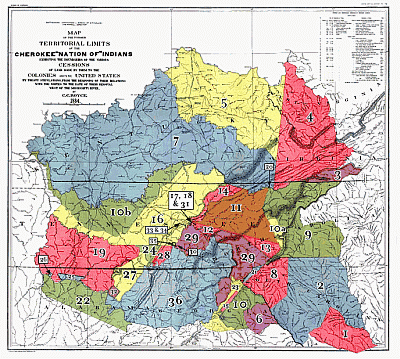
View Library of Congress Map
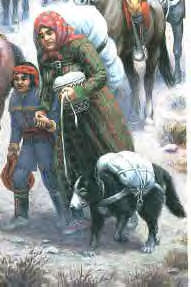
Removal: The Trail Of Tears
The Cherokee Nation of Oklahoma comprises over 288,000 Cherokees, worldwide, with their tribal complex in Tahlequah, Oklahoma. Visit the official site of the Cherokee Nation of Oklahoma.
There is NO reservation in Oklahoma. The Cherokee Nation of Oklahoma is a Sovereign Nation that maintains a special relationship with both the United States and Oklahoma governments.
Not all of the Cherokees migrated west to Indian Territory during the Trail of Tears. Some Cherokees moved west before the Trail of Tears, settling in an area known then as the "Arkansas Territory." The United Keetoowah Band of Cherokee Indians are one such group who settled in the territory in 1817. Today there are over 14,300 UKB Cherokees, who primarily reside in Oklahoma, with their capital being in Tahlequah.
Some groups stayed behind after the Trail of Tears. One such group is the Eastern Band of Cherokee Indians whose population exceeds 12,000, more than half of whom reside on the reservation, called the "Qualla Boundary."
Some groups have yet to receive recognition from the United States Government, but are recognized by individual state governments, such as the Cherokee Tribe of Northeast Alabama, the Echota Cherokee Tribe of Alabama, the Georgia Tribe of Eastern Cherokee, and the Southern Cherokee Nation of Kentucky.
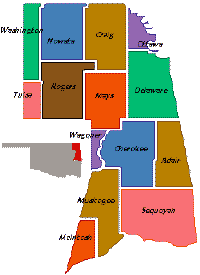
The Cherokee Nation is located in Northeastern Oklahoma and comprised of 14 counties.
Page updated:

State Coordinator: Linda K. Lewis
Asst State Coordinator: Rebecca Maloney
Designed by Templates in Time