


The Wyandot, whose traditional name is Wandat, are an Indigenous people of the Northern Iroquoian language family. Their history reaches from the Great Lakes and Ohio country to Kansas and, ultimately, Indian Territory. Today, the Wyandotte Nation is a federally recognized tribe headquartered at Wyandotte, Oklahoma.
The Wyandot's nineteenth-century history is especially important to Oklahoma researchers. After removal from Ohio to Kansas in the 1840s, the Nation experienced allotment and termination of its tribal status. In 1867, Wyandot people who had refused U.S. citizenship and later sought restoration of their tribal status were recognized again as a tribe and moved to a reservation in northeastern Indian Territory.
| Year | Event |
|---|---|
| 1600s | Wyandot ancestors lived in the Great Lakes region. The Wyandotte Nation identifies the Tionontati, Attignawantan, and Wenrohronon among the peoples whose remnants united during the seventeenth century. |
| 1649-1650 | Following warfare and displacement involving the Iroquois Confederacy, remnants of several related peoples united and moved westward. |
| 1700s | Wyandot communities became established in the Ohio River Valley, the Detroit area, and present-day Ohio and Indiana. |
| 1785 | The Treaty of Fort McIntosh included the Wyandot and other Native nations and established boundaries for lands claimed by the United States. |
| 1795 | The Treaty of Greenville resulted in additional cessions of Native lands, including lands involving the Wyandot. |
| 1817-1818 | Treaties resulted in further loss of Wyandot lands in Ohio and surrounding areas. A Wyandot reservation was established at Upper Sandusky, Ohio. |
| 1842 | The Treaty of March 17, 1842, ceded the remaining Wyandot lands in Ohio and Michigan to the United States and provided for a new home west of the Mississippi River. |
| 1843 | The Wyandot left Ohio and moved west. They purchased approximately 40,000 acres from the Delaware in what became eastern Kansas and established a reservation there. |
| 1855 | The Treaty of January 31, 1855, resulted in allotment of Wyandot lands and termination of the tribe as a federally recognized political entity. Many Wyandot became U.S. citizens. |
| 1857 | Wyandot people who did not accept U.S. citizenship moved from Kansas to Indian Territory, where they lived among the Mixed Band of Seneca and Shawnee. |
| 1867 | The Treaty of February 23, 1867, restored the Wyandot as a tribal entity and provided for their establishment in Indian Territory. A reservation of approximately 20,000 acres was established in northeastern Indian Territory. |
| 1867-1871 | Wyandot people in Indian Territory were associated with the Neosho Agency. |
| 1871-1880 | The Quapaw Agency administered federal Indian affairs for the Wyandot and other tribes in northeastern Indian Territory. |
| 1995 | The Wyandotte Nation received self-governance authority from the Bureau of Indian Affairs. |
| Today | The Wyandotte Nation is headquartered in Wyandotte, Oklahoma, and continues to maintain its government, cultural programs, museum, and genealogical resources. |
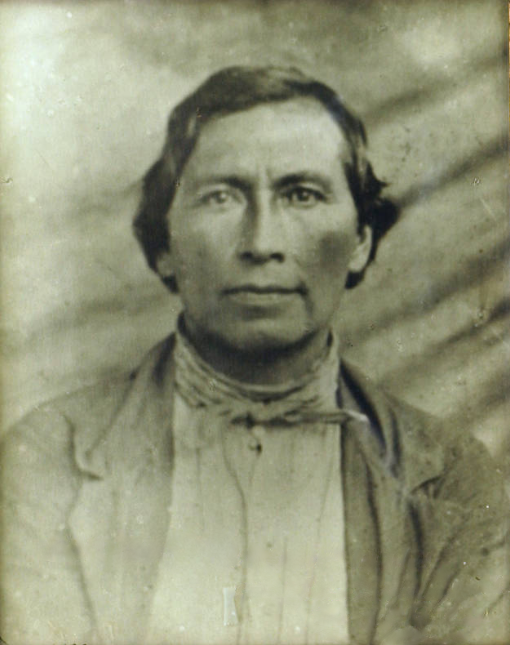
John Solomon, ca. 1870
Wyandotte Sheriff
Removal to Kansas was a major turning point in Wyandot history. Under the Treaty of 1842, the United States obtained the Wyandot lands in Ohio and Michigan and promised the Nation a new home west of the Mississippi River.
In 1843, the Wyandot settled in what is now the Kansas City area. Because suitable land had not initially been made available as promised, the Wyandot purchased approximately 40,000 acres from the Delaware. Their Kansas reservation became an important center of Wyandot political and community life.
The Wyandot community played a significant role in the development of Kansas City, Kansas. The city was originally known as Wyandot City, reflecting the importance of the Wyandot in the area's early history.
The Treaty of January 31, 1855, fundamentally changed the political status of the Wyandot. The reservation was divided into individual allotments, and the Wyandot were granted U.S. citizenship. The federal government subsequently treated the tribe as terminated.
Not all Wyandot accepted citizenship or the loss of their tribal government. Some moved to Indian Territory in 1857, while others remained in Kansas.
For genealogists, this period can produce records in both Wyandot tribal records and ordinary Kansas and federal citizenship, land, and census records. A family may therefore appear under very different record systems before and after 1855.
In 1857, a group of Wyandot who did not accept U.S. citizenship moved to Indian Territory. They lived as guests of the Mixed Band of Seneca and Shawnee.
Following the Civil War, Wyandot leaders sought restoration of their tribal status. The Treaty of February 23, 1867, provided for the restoration of the Wyandot as a tribal entity and established a reservation of approximately 20,000 acres in northeastern Indian Territory.
The area is now in northeastern Oklahoma near the present communities of Wyandotte and Miami.
The Wyandotte Nation is a federally recognized tribe headquartered in Wyandotte, Oklahoma. The Nation maintains a Cultural Center and Museum, Tribal Heritage Department, and library where visitors can conduct family research.
The Nation also preserves traditional history and language, including the Wandat language and traditional clan information.
When researching a Wyandot ancestor, search across several geographic locations and record systems. A family that was identified as Wyandot in Ohio may appear in Kansas records after removal and later in Indian Territory records under the Wyandotte name.
Federal agency records are particularly valuable for researchers tracing Wyandot ancestors after removal to the West. The National Archives identifies the following agency relationships:
Agency records may contain correspondence, census information, land and allotment material, annuity information, school records, reports, and other documentation concerning individual Wyandot families.
Important: The terms Huron, Wyandot, and Wyandotte appear in historical records in different contexts. Researchers should examine the original record rather than assuming that every person identified by one of these terms belonged to the same political organization.
The National Archives treaty catalog is an excellent starting point for tracing Wyandot history. Among the treaties involving the Wyandot are:
These treaties can be particularly valuable when establishing the location of a family at a specific point in time and understanding why the family subsequently appears in a different state or federal jurisdiction.
The Wyandot story is a history of movement and survival-from the Great Lakes and Ohio country, to Kansas, and finally to Indian Territory. For descendants, researching this history geographically can be just as important as searching by surname.
When a Wyandot ancestor disappears from Ohio records, look to Kansas. When the family disappears from Kansas after the 1850s, look to Indian Territory. And when searching federal records in Oklahoma, pay particular attention to the Neosho Agency, Quapaw Agency, and Central Superintendency.
The records created during each of these periods can help connect the same family across generations, even when the name used for the tribe or the government agency has changed.
Page updated:

State Coordinator: Linda K. Lewis
Asst State Coordinator: Rebecca Maloney
Designed by Templates in Time