


Welcome to the Tonkawa history and genealogy page. Whether you are tracing a Tonkawa ancestor, researching a Tonkawa family in Oklahoma, or learning more about the Tonkawa people, these resources can help you discover the people in your family history. The Tonkawas travel spans Texas, Indian Territory, and northern Oklahoma. The Tonkawa were moved several times during the nineteenth century before establishing their permanent home in present-day Kay County, Oklahoma. Tonkawa genealogy is especially rich in federal Indian census and agency records. Begin with your most recent documented ancestor and work backward, using census, allotment, agency, birth, death, marriage, school, and land records to connect one generation to the next.
| Year | Event |
|---|---|
| 1600s | Early European accounts place the Tonkawa in the southern Great Plains. More recent scholarship places Tonkawa people in present-day northwestern Oklahoma by the early 1600s. |
| 1700s | The Tonkawa lived across parts of present-day Oklahoma and Texas and became closely associated with the Lipan Apache and other peoples of the southern Plains. |
| 1830s | Tonkawa communities increasingly moved toward central and southern Texas as conflict and pressure from other Native nations and expanding settlement affected their traditional territory. |
| 1854 | The Tonkawa were settled on the Brazos River Reservation in Texas along with several other Native groups. |
| 1859 | The Tonkawa were removed from Texas to Indian Territory and placed under the Wichita Agency in the Leased District near Fort Cobb. |
| 1862 | On October 24, the Tonkawa Massacre occurred near present-day Anadarko. The attack devastated the Tonkawa population. |
| 1860s-1880s | After the Civil War, the surviving Tonkawa returned to Texas and lived near Fort Griffin. |
| 1884 | The Tonkawa were removed from Texas and transported by railroad to Indian Territory. They spent the winter at the Sac and Fox Agency before continuing north. |
| 1885 | The Tonkawa reached their permanent reservation near the former Oakland Agency in present-day Kay County, Oklahoma. |
| 1886 | Annual Tonkawa Indian census records begin in the federal census series, providing an important source for Oklahoma genealogy. |
| 1891 | The Tonkawa reservation was allotted to 73 individuals. Allotment records became an important source for identifying Tonkawa families and land holdings. |
| 1893 | The Cherokee Outlet opened to non-Indian settlement. The Tonkawa reservation had already been allotted, and the surrounding area rapidly changed as settlement expanded. |
| 1900s | Tonkawa families continued to appear in federal Indian census, agency, land, school, birth, and death records. |
| 1936 | The Tonkawa Tribe reorganized under the Oklahoma Indian Welfare Act. |
| Today | The Tonkawa Tribe of Oklahoma is headquartered near the city of Tonkawa in Kay County and maintains its tribal reserve and community there. |
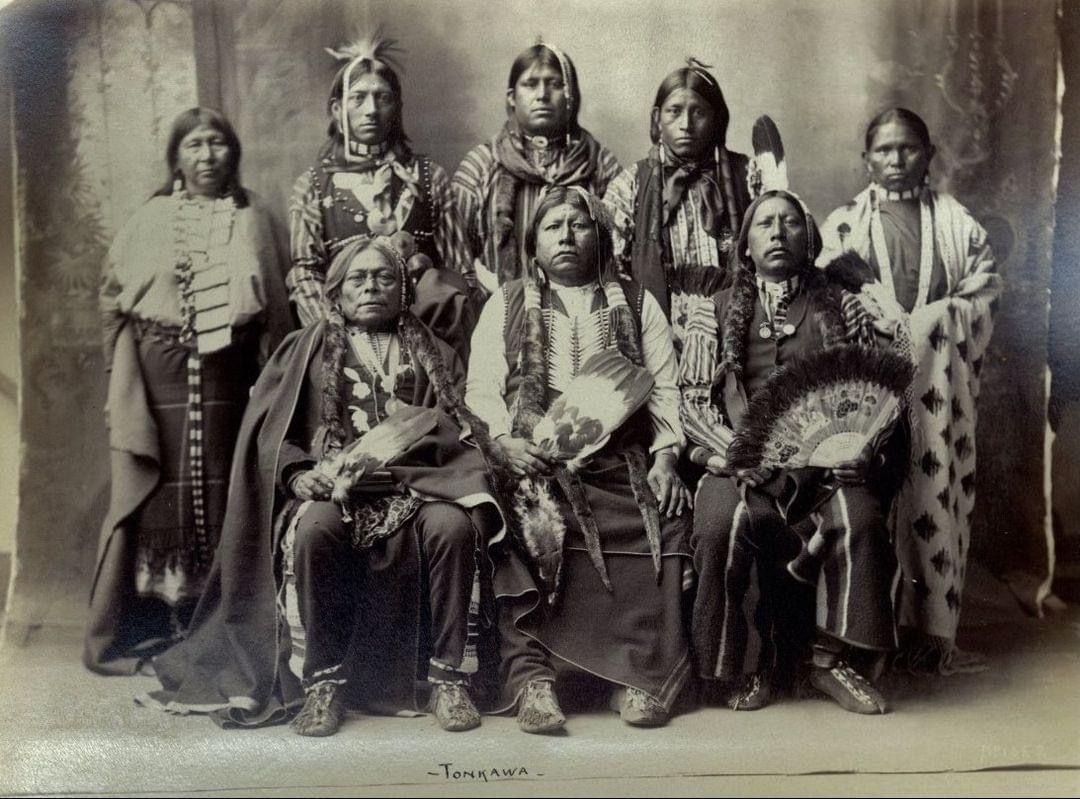
Tonkawa Chiefs, 1898
Standing L-R: Winnie Richards, John Rush Buffalo, William Stevens, John Allen,
and Mary Richards. Seated L-R: John Williams, Grant Richards, and Sherman Miles
The Tonkawa are an Indigenous people of the southern Great Plains. The Tonkawa Tribe describes its traditional name as Tickanwa-tic, meaning "real people." The name Tonkawa is generally associated with a Waco term translated as "they all stay together." The Tonkawa language was distinctive and belonged to the Tonkawan language family. Historically, Tonkawa communities were mobile, following buffalo and other game across the southern Plains. Hunting, trading, horsemanship, and relationships with neighboring Native peoples were important parts of Tonkawa life. During the eighteenth and nineteenth centuries, the Tonkawa maintained relationships with the Lipan Apache and developed connections with Spanish, Mexican, Texan, and later United States authorities.
By the nineteenth century, much of the Tonkawa population was living in Texas. Increasing conflict and the expansion of non-Indian settlement resulted in repeated efforts by the United States to place the Tonkawa on reservations. In 1854 the Tonkawa were settled on the Brazos River Reservation in Texas. In 1859 they were moved to Indian Territory and placed under the Wichita Agency in the Leased District near Fort Cobb.
The Civil War was a devastating period for the Tonkawa. The Tonkawa were associated with Confederate forces, which contributed to hostility between the Tonkawa and some neighboring Native peoples who supported the Union. On October 24, 1862, pro-Union Indian forces attacked the Tonkawa near the Wichita Agency. The event became known as the Tonkawa Massacre. The Tonkawa population suffered catastrophic losses, and the tribe never recovered its nineteenth-century population. The surviving Tonkawa eventually returned to Texas, where they lived near Fort Griffin before their final removal to Indian Territory in 1884.
In October 1884, the Tonkawa were removed from Fort Griffin, Texas. According to the Tonkawa Tribe, the people traveled by railroad from Cisco, Texas, to the Sac and Fox Agency in Indian Territory. They spent the winter there before continuing north by wagon. In June 1885 the Tonkawa reached the former Oakland Agency area in present-day Kay County, Oklahoma. The reservation was also occupied by the Lipan Apache, who had been incorporated with the Tonkawa community. The Tonkawa homeland in northern Oklahoma remains the center of the Tribe today.
Tonkawa genealogy can be particularly rewarding because the federal government kept a long series of annual census records for the Tonkawa beginning shortly after their arrival in Oklahoma. When researching an ancestor, do not rely on a single census entry. Compare the person's age, spouse, children, parents, household members, residence, and allotment information from year to year. Because the Tonkawa population was small, extended family relationships can be especially helpful in identifying the correct person. A sibling, parent, spouse, or child may provide the clue needed to distinguish two people with similar names.
The Tonkawa census collection is one of the most important resources for Oklahoma genealogy. The Oklahoma Historical Society lists Tonkawa census records from 1886 through the 1930s, with many of the original records held on National Archives microfilm. Important census records are listed below. These records may provide names, ages, family relationships, residence, tribal affiliation, births, deaths, and other information. The exact information varies from one census to another.
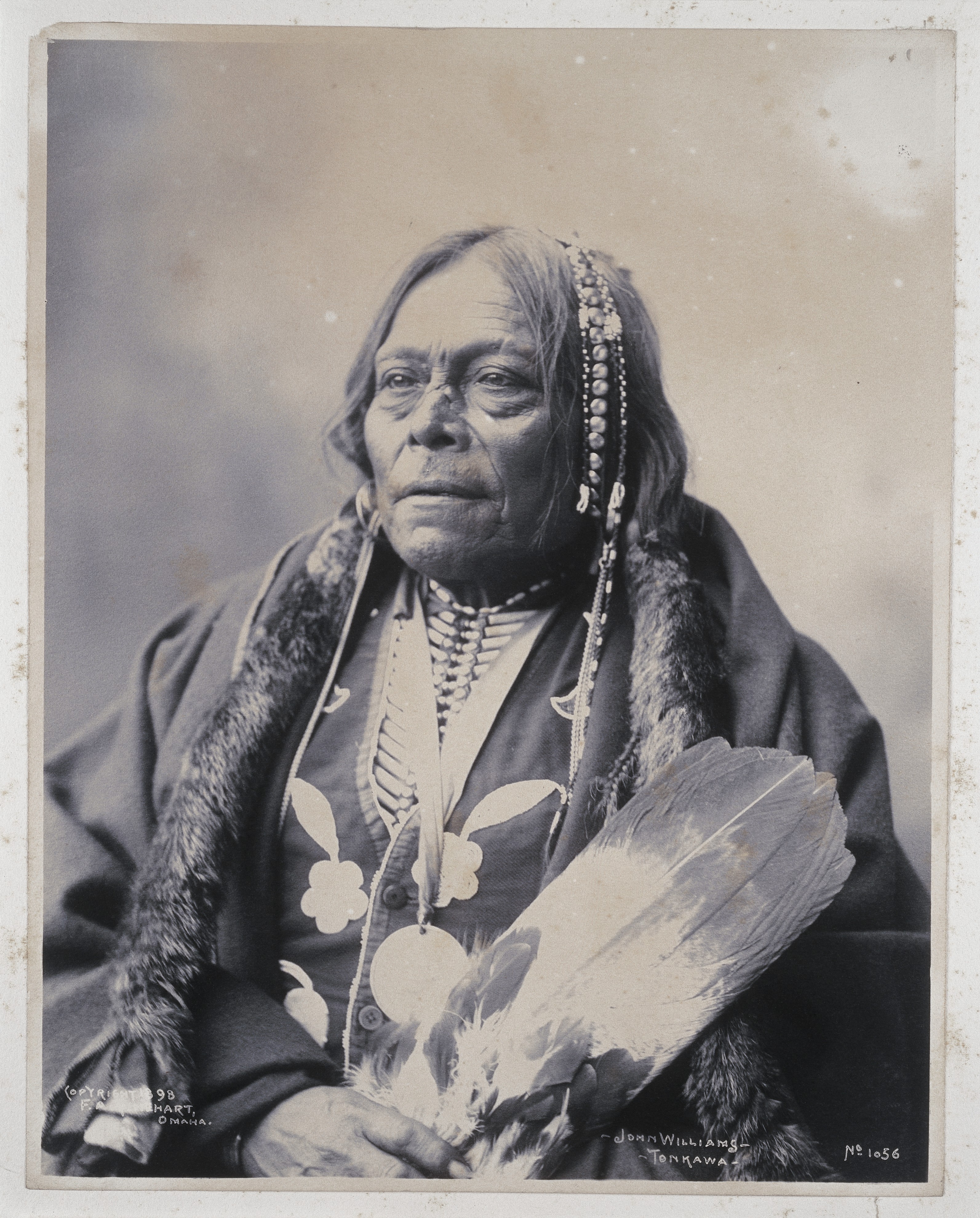
Tonkawa Chief John WIlliams, 1898
After the Tonkawa were established in northern Oklahoma, many Tonkawa records were maintained through the Ponca Agency. The Oklahoma Historical Society holds several Tonkawa census records created through the Ponca Agency, including the 1922 and 1926 censuses. The National Archives also identifies Ponca Agency records among the federal records relating to the Tonkawa. These records can supplement the annual Indian census rolls and may contain correspondence, administrative records, land information, and other material concerning Tonkawa families.
The National Archives identifies Tonkawa Subagency records at both the Oklahoma Historical Society and the National Archives at Fort Worth. The Oklahoma Historical Society holds Tonkawa Subagency records for 1911-1917, while the National Archives at Fort Worth holds records for 1913-1919. Agency records can be valuable when a census entry does not provide enough information to establish a family relationship. Correspondence and administrative files may contain information about individual tribal members, land, education, family matters, and other events.
The Tonkawa reservation was allotted to 73 individuals in 1891. Allotment records are therefore an important source for identifying Tonkawa families and determining where individual members received land. Land records can also help connect a Tonkawa ancestor with a particular location in Kay County and surrounding communities.
An allotment file may provide:
Later Tonkawa census records include separate birth and death information. These records can be particularly helpful for extending a family line into the twentieth century. Compare agency birth and death records with Oklahoma state records, county records, cemetery records, obituaries, and family records whenever possible. A death record may provide an age or family relationship that helps identify the same person in an earlier census.
School and pupil enrollment records can provide another way to connect children with their parents and households. The Oklahoma Historical Society's American Indian Census collection includes school and pupil enrollment material among the types of Indian records available in its research collections. When searching school records, look for the child's name as well as the names of siblings and parents. Children may also appear under different spellings or shortened versions of their names.
The Tonkawa and Lipan Apache have an important shared history in Oklahoma. Lipan Apache people who were living near Fort Griffin were removed to Indian Territory in 1884 and were incorporated into the Tonkawa community. The two groups shared the reservation in present-day Kay County. This connection is important for genealogy. A family record may identify a person as Tonkawa, Lipan, or both, depending on the record and the period in which it was created.
The present city of Tonkawa was named for the tribe. The town was established after the Cherokee Outlet opened to non-Indian settlement and was platted in 1894. The tribal reserve is located near the city of Tonkawa in northern Kay County. The Tonkawa Tribe continues to maintain its community and tribal government in this area. County records from Kay County can therefore be useful when researching Tonkawa families, particularly after allotment and statehood.
If your Oklahoma Tonkawa ancestor was born before the 1884 removal, Texas records may be essential. The Tonkawa lived in several locations in Texas, including the Brazos River Reservation and the Fort Griffin area. Look for:
When working backward from an Oklahoma census, establish the person's age and family relationships first. Then use those details to search Texas records for the earlier generation.
Tonkawa genealogy often begins with Oklahoma records and then moves backward into Texas. The long series of Tonkawa Indian census records makes it possible to follow many families from the late nineteenth century into the twentieth century. Use the census records as a framework, then strengthen the family connections with allotment, agency, birth, death, school, land, and county records. Pay attention to the names of relatives because extended family relationships can be especially important when researching a small population. The Tonkawa people endured repeated removals and profound losses during the nineteenth century, yet maintained their identity and community. Today the Tonkawa Tribe remains rooted in northern Oklahoma, near the reservation that became its home in 1885.
Page updated:

State Coordinator: Linda K. Lewis
Asst State Coordinator: Rebecca Maloney
Designed by Templates in Time