


Welcome to the Shawnee history and genealogy page. The Shawnee people have a long history of movement across the eastern United States, the Midwest, Kansas, Indian Territory, and Oklahoma. For family historians, that history means an ancestor may appear in records from several different places before the family is found in Oklahoma.
This page focuses on the Shawnee Tribe, formerly known as the Loyal Shawnee or Cherokee Shawnee. The Shawnee Tribe is one of three federally recognized Shawnee tribes in Oklahoma, along with the Absentee Shawnee Tribe and the Eastern Shawnee Tribe of Oklahoma. If you are researching a Shawnee ancestor, do not assume that every historical record referring simply to "Shawnee" belongs to the same Oklahoma tribal community. Follow the person's family, location, agency, reservation, and allotment records to determine which Shawnee community they belonged to.
Linda K. Lewis, Site Coordinator
The Shawnee homeland was centered in the Ohio Valley and surrounding regions. During the late eighteenth and early nineteenth centuries, different Shawnee communities moved westward as the United States expanded into their homelands. Today the Shawnee Tribe is headquartered in Miami, Oklahoma. The tribe maintains its own government, citizenship system, cultural programs, and historic preservation activities.
| Year | Event |
|---|---|
| 1825 | Shawnee from Missouri received a reservation in Kansas. The group that later became the Shawnee Tribe remained associated with the Kansas Shawnee reservation. |
| 1831 | Shawnee in Ohio ceded their remaining lands and moved to Kansas. |
| 1840s | Some Kansas Shawnee joined relatives who had already moved to Indian Territory along the Canadian River. |
| 1854 | A new treaty reduced the Kansas Shawnee reservation and provided for individual land ownership. |
| 1861-1865 | During the Civil War, many Kansas Shawnee supported the Union. Their service later contributed to the name Loyal Shawnee. |
| 1869 | The Loyal Shawnee entered into an agreement with the Cherokee Nation and received Cherokee citizenship. |
| 1870s | Most Loyal Shawnee moved from Kansas to the Cherokee Nation in Indian Territory, settling primarily in what became northeastern Oklahoma. |
| 1883 | The Wallace Roll documented Cherokee-Shawnee. |
| 1889 | Another Shawnee roll was created under federal legislation. |
| 1901 | Shawnee allotments within the Cherokee Nation were documented through the Dawes Commission process. |
| 2000 | Federal legislation restored the Shawnee Tribe as a federally recognized tribe separate from the Cherokee Nation. |
| 2001 | The Bureau of Indian Affairs approved the Shawnee Tribe's base roll. |
Kansas records are an important part of Shawnee genealogy. After the Shawnee moved from Ohio, they occupied a large reservation in Kansas. The reservation was later reduced, and individual Shawnee received land through the treaty and allotment process. Some families remained in Kansas for decades, while others moved to Indian Territory before the Civil War. Consequently, a family with later Oklahoma connections may have several generations documented in Kansas before appearing in Indian Territory records. When researching a nineteenth-century Shawnee ancestor, search both Kansas and Indian Territory records rather than assuming the family remained in one location.
The Shawnee who became the Loyal Shawnee experienced a different path to Oklahoma than the Absentee Shawnee and Eastern Shawnee. Following the Civil War, the Loyal Shawnee negotiated an agreement with the Cherokee Nation. In 1869, 722 Loyal Shawnee were granted Cherokee citizenship. By 1871, most had settled in the Cherokee Nation, particularly in present-day Craig and Rogers counties. Because of this history, Shawnee ancestors may appear in both Shawnee and Cherokee records. A Cherokee record does not necessarily mean that the individual was Cherokee by ancestry; in this period, some Shawnee held Cherokee citizenship through the 1869 agreement.
Shawnee genealogy often requires working through several different record systems. Begin with the most recent documented ancestor and work backward, carefully establishing each parent-child relationship.
Important historical search terms include:
Records may identify an ancestor by a tribal designation, by residence, or by the agency or nation administering the record. Always compare the person's location and family relationships with the record itself.
The Shawnee Tribe's current citizenship requirements identify several historical rolls that are particularly important to genealogists:
The Shawnee Tribe also notes that descendants may establish eligibility through documentation showing that an ancestor received an allotment within the Shawnee Reservation in Kansas under the 1854 treaty. See the Shawnee Tribe's information about Citizen Enrollment
Because the Loyal Shawnee became citizens of the Cherokee Nation, their families can appear in the Dawes Commission records for the Cherokee Nation. Dawes records may include applications, enrollment cards, testimony, correspondence, family information, and allotment records. These documents can be especially valuable for connecting a Shawnee ancestor living in Oklahoma to earlier generations in Kansas. When searching Dawes records, do not search only for the surname. Look for the individual's name, parents, spouse, residence, and Shawnee identification. Variations in spelling are common.
The Oklahoma Historical Society's American Indian Census collection includes several records that can help researchers identify Shawnee families. The Oklahoma Historical Society notes that its American Indian Census collection includes not only censuses but also citizenship cases, emigration lists, payment records, births, deaths, marriages, divorces, and school enrollment records. See their Shawnee Census Records.
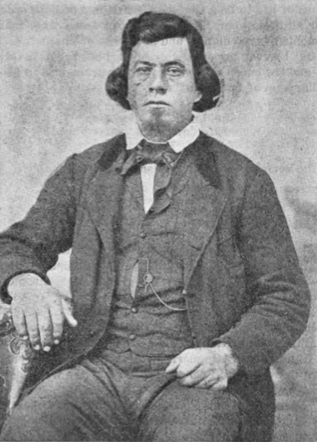
Charles Bluejacket, 1816-1897
Shawnee Leader in Kansas
For families who remained in Kansas, land records may be as important as tribal census records. The 1854 treaty provided for Shawnee land allotments, and restricted land patents can provide evidence of an ancestor's connection to the Shawnee Reservation. The Shawnee Tribe specifically identifies restricted land patents in Johnson, Douglas, and Shawnee Counties, Kansas as potential evidence for citizenship research. Search Kansas county deed records, federal land records, probate files, and historical newspapers alongside Shawnee-specific records.
School records can provide valuable information about Shawnee children and their families. The 1917 census of Big Jim Shawnees and school census is one example of a record that can place children within a particular Shawnee family and community.School records may provide children's names, ages, parents, residence, attendance, and other information that helps distinguish families with the same surname.
Shawnee research can be complicated by spelling variations and the use of English names, Shawnee names, nicknames, and names recorded differently by federal agents. When a name appears in several records, compare the following items. A combination of these details is often more reliable than a surname alone.
There are three federally recognized Shawnee tribes in Oklahoma. Their histories overlap, but they represent distinct communities and have different enrollment and historical records. See Oklahoma Tribal Governments from the Oklahoma Historical Society for more info.
Shawnee genealogy often crosses state and tribal boundaries. A family may begin in Ohio, appear in Missouri or Kansas, move into Indian Territory, and later appear in Cherokee Nation, Oklahoma county, and federal records. The most useful approach is to follow the family rather than a single record series. Establish each generation with more than one source whenever possible, and pay particular attention to the rolls, allotment records, and family relationships that connect the Shawnee community in Kansas with the Shawnee Tribe in Oklahoma. With patience and careful comparison of records, these documents can turn scattered names and dates into a connected Shawnee family history.
Page updated:

State Coordinator: Linda K. Lewis
Asst State Coordinator: Rebecca Maloney
Designed by Templates in Time