


Welcome to the Otoe-Missouria history and genealogy page. Whether you are tracing an Otoe or Missouria ancestor, researching a family connected to Oklahoma, or following a family through the Great Plains, these resources can help you discover the people behind your family history. The Otoe and Missouria have separate origins but became closely connected during their history. Both peoples were associated with the central Great Plains before removal to Indian Territory. Their Oklahoma history is closely connected to the Great Nemaha Reservation in Nebraska and Kansas and to the Otoe-Missouria reservation established in present-day Noble and Pawnee counties, Oklahoma.
When researching an Otoe-Missouria ancestor, search both Otoe and Missouria records. Historical documents may identify an individual by either tribal connection, particularly during periods when the two communities lived together.
| Year | Event |
|---|---|
| 1600s | The Otoe and Missouria lived in the central Great Plains and upper Missouri River region. Both peoples spoke Siouan languages and maintained extensive relationships with neighboring Native nations. |
| 1700s | The Otoe were closely associated with the Platte River region, while the Missouria were associated with the Missouri River. The two peoples increasingly lived and traveled together. |
| 1804 | Lewis and Clark encountered the Otoe and Missouria during their expedition along the Missouri River. |
| 1830 | The Otoe-Missouria entered into a treaty with the United States establishing a reservation along the Platte River in present-day Nebraska. |
| 1854 | The Otoe-Missouria ceded most of their Nebraska lands and retained a smaller reservation along the Big Blue River in Nebraska and Kansas. |
| 1865 | The Otoe-Missouria agreed to cede their remaining lands in Nebraska and Kansas and move south to Indian Territory. |
| 1881 | The Otoe-Missouria reservation was formally established in Indian Territory. The reservation occupied lands in present-day Noble and Pawnee counties, Oklahoma. |
| 1887 | The Dawes Act introduced the federal allotment system. Otoe-Missouria lands were eventually allotted to individual tribal members. |
| 1890s | Otoe-Missouria families appeared in federal Indian census, allotment, agency, and school records as the reservation community developed. |
| 1907 | Oklahoma statehood brought the Otoe-Missouria reservation into the new state of Oklahoma. |
| 1936 | The Otoe-Missouria Tribe reorganized its government under the Oklahoma Indian Welfare Act. |
| Today | The Otoe-Missouria Tribe is headquartered in Red Rock, Oklahoma, and continues to maintain its tribal government, community, and cultural programs. |
The Otoe are a Siouan-speaking people whose earlier history is connected with the Great Lakes and central Plains. Over time, Otoe communities moved westward and became closely associated with the Platte River and central Great Plains. By the eighteenth century, the Otoe were established along the Platte and lower Missouri River regions. They maintained relationships with neighboring Native peoples and participated in trade with French, Spanish, and later American traders.The name Otoe is also encountered in historical records as Oto, Otoes, or other spellings. Genealogists should search for spelling variations when working with older records.
The Missouria were also a Siouan-speaking people. Their name became associated with the Missouri River and eventually gave the river and state of Missouri their names. By the eighteenth century, warfare and disease had greatly reduced the Missouria population. Survivors increasingly lived with the Otoe, and the two communities became closely connected. Historical records may therefore identify an ancestor as Missouria, Otoe, Otoe-Missouria, or by another description depending on the period and record keeper.
The Otoe and Missouria encountered Lewis and Clark during the Corps of Discovery expedition in 1804. The expedition met Otoe and Missouria leaders near present-day Nebraska City, Nebraska. The encounter is one of the better-known moments in the written history of the Otoe-Missouria, but genealogical research should rely on individual records rather than assuming that an ancestor mentioned in an expedition account was part of a particular later family.
In the nineteenth century, federal treaties increasingly restricted Otoe-Missouria lands. In 1830 the United States established a reservation for the Otoe and Missouria along the Platte River. Later treaties reduced the reservation. By 1854, the Otoe-Missouria had ceded most of their lands and retained a much smaller reservation along the Big Blue River in Nebraska and Kansas. The Great Nemaha Reservation became an important part of the history of the Otoe-Missouria and other Native peoples relocated to the region. Records from this period are essential when researching ancestors who later moved to Oklahoma.
In 1865, the Otoe-Missouria agreed to sell their remaining lands in Nebraska and Kansas and move south to Indian Territory. The move was part of the larger federal policy of concentrating Native nations in Indian Territory. The Otoe-Missouria established their community in the area that became northern Oklahoma. Their reservation eventually encompassed lands in present-day Noble and Pawnee counties.
The Otoe-Missouria reservation became the permanent home of the Tribe in Oklahoma. The community developed around present-day Red Rock, Oklahoma. The Otoe-Missouria were surrounded by other Native nations and communities in Indian Territory, including the Ponca, Pawnee, Osage, Iowa, Sac and Fox, and Kaw. This makes agency and neighboring tribal records potentially useful when researching individual families.
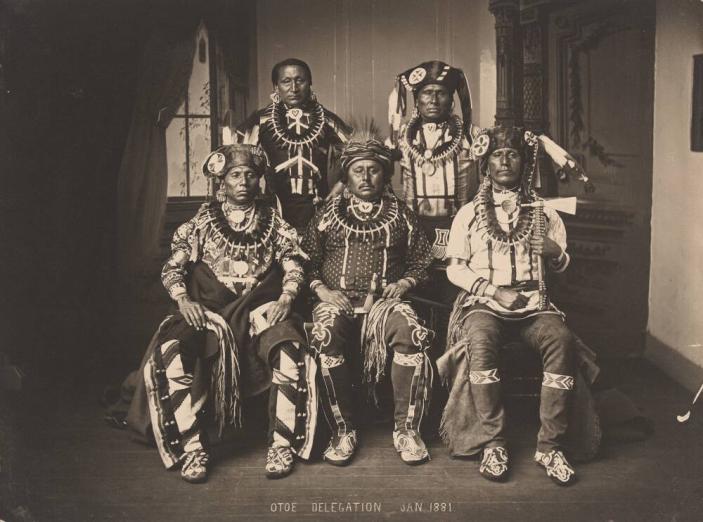
Otoe-Missouria, 1881 Delegation to Washington
Waruje Nayi, Munje Xanje, Hari Gra, Ma Ska Gaxe, Chedo Navi (aka James Arkeketa)
Otoe-Missouria genealogy often requires research in both pre-Oklahoma and Oklahoma records. An ancestor who appears in an Oklahoma census may have parents or grandparents who lived on the Great Nemaha Reservation or elsewhere in Nebraska, Kansas, Iowa, or Missouri. Because the Otoe and Missouria became closely associated, search for both tribal names. A person who was described as Missouria in one record may appear in an Otoe or Otoe-Missouria record in another. Begin with the most recent documented ancestor and work backward. Record the names of spouses, children, parents, siblings, and other relatives. These relationships can be more useful than a surname alone for identifying the correct family.
Federal Indian census rolls are an important source for Otoe-Missouria genealogy. Census records can provide names, ages, family relationships, residences, and tribal affiliation. When searching the records, look for the Otoe-Missouria under the agency responsible for the community at the time. Records may also identify individual families using Otoe, Missouria, or Otoe-Missouria terminology. Search consecutive years whenever possible. Comparing a household from one year to another can reveal marriages, births, deaths, children leaving the household, and other family changes.
Allotment records are especially important for Oklahoma Otoe-Missouria research. Federal allotment divided reservation lands among individual tribal members and created extensive documentation concerning l and ownership. Land records can help place an ancestor geographically and can provide clues about nearby relatives.
An allotment file may provide:
The Dawes Commission records are an important source for many Native American families in Oklahoma. Enrollment and allotment records can contain information concerning an individual's age, family relationships, residence, and tribal status. Researchers should remember that enrollment records were created for specific legal and administrative purposes. Information can differ from earlier family or agency records, so compare the Dawes material with census, birth, death, and other records.
School records can provide valuable information about Otoe-Missouria children and their families. Indian schools and federal agencies recorded student names, ages, parents, attendance, and other information. When researching a child, search for siblings as well as parents. School records can sometimes identify family relationships that are difficult to establish from census records alone.
Vital information may appear in federal Indian agency records as well as Oklahoma civil records. Later records may provide dates and places of birth, death, and marriage that can help connect an individual to an earlier generation. Search for alternate spellings of names and compare the information with census and allotment records. An obituary or cemetery record may also provide names of parents, spouses, or children.
For Otoe-Missouria ancestors who lived before removal, Nebraska and Kansas records are essential. The Great Nemaha Reservation was an important part of Otoe-Missouria history before the move to Indian Territory. The Kansas Historical Society and Nebraska State Historical Society can be particularly useful when researching this period.
Look for:
The Missouria connection makes Missouri records important for some Otoe-Missouria families. Earlier generations may appear in records under Missouria, Otoe, or other historical spellings. French, Spanish, and American records may use different spellings for Native names. Search broadly and use family relationships and locations to determine whether records refer to the same person.
The Otoe-Missouria lived among many other Native nations during their history. In Oklahoma, neighboring communities included the Ponca, Pawnee, Osage, Iowa, Sac and Fox, and Kaw. These relationships can be useful in genealogy. A marriage, adoption, household connection, or migration may cause an ancestor to appear in records associated with another tribe or agency. Do not automatically exclude a record because it is filed under a neighboring agency. Instead, compare names, relatives, ages, locations, and other identifying information.
Otoe-Missouria genealogy often crosses several states and several generations. A family found in Oklahoma may have earlier connections to the Great Nemaha Reservation in Nebraska and Kansas, while still earlier generations may lead to Iowa, Missouri, or the central Great Plains Search both Otoe and Missouria records, and use census, agency, enrollment, allotment, school, land, and vital records together. Family relationships are often the key to connecting records created under different tribal or agency names. The Otoe and Missouria experienced major changes in location and government during the nineteenth century, but their descendants continue to maintain their community and identity in Oklahoma. Their history provides an important connection between the Native peoples of the Missouri and Platte River regions and the Native nations of present-day Oklahoma.
Page updated:

State Coordinator: Linda K. Lewis
Asst State Coordinator: Rebecca Maloney
Designed by Templates in Time