


The Kaw Tribe, known as "the wind people", originally lived along the lower Kansas River in villages consisting of conical-shaped lodges.
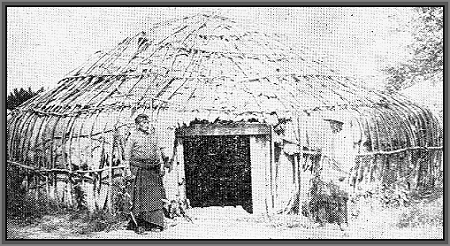
Kaw Bark Lodge, ca. 1880
Formerly known as the Kansa (or Kanza), the Kaw Tribe at one time stretched over 20 million acres across northern Kansas into Nebraska and Missouri. In 1825, a treaty was signed by the Kanza Tribe in which the Tribe "agreed" to sell a large portion of its land base and relocated to a reservation near present day Topeka, Kansas. The Kaw lived a semi-nomadic life, depending primarily on buffalo hunting and some farming for their food. They obtained social prestige and honor only in combat, and their chiefs were chosen for bravery and wisdom. The culture of the Kaw was that of the Plains people of the central United States. Typical of the Plains culture area, adolescent boys underwent a puberty rite known as the vision quest - a period of isolation meant to invoke supernatural images. Religious beliefs were centered around spirits associated with nature. Highly developed burial customs were followed; the body was placed in a shallow grave with food, clothing, and other needs for the afterlife.
By 1840 the lands of the Kaw had been acquired by the United States government and incorporated into the so-called Indian Territory, to which many Native Americans were being removed. In 1846, the Kaw numbering about 1,600, signed another treaty and moved southwestward near what is known today as Council Grove, Kansas.
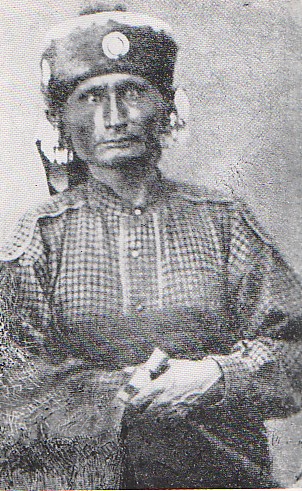
Chief Al-le-ga-wa-ho
One of three principal chiefs in 1867
In 1872, the Secretary of the Interior of the U.S. government, Columbus Delano, came to Council Grove to inform the Kaw that they would be removed from Kansas. Kaw chief Al-le-ga-wa-ho made a plea with the following words: "Great Father, you whites treat us Kan-zey like a flock of turkeys, you chase us to one stream, then you chase us to another stream, soon you will chase us over the mountains and into the ocean." The chief's appeal was ignored, and in June 1873, the six hundred remaining Kaw were removed south to a reservation in Indian Territory, where they have since remained. Of those, an epidemic of small pox killed another 400.
By 1904, the Kaw had agreed to accept allotments which allowed for each member in the Tribe to receive 405 acres of reservation land with the remaining land to be opened up to white settlement.
In the early 20th century the Kaw population was estimated at about 1300. Their numbers steadily decreased, decimated by frequent warfare and disease. By 1990 only 1037 people identified themselves as Kaw. Of those, 59 percent lived in Oklahoma. A celebrated tribal member was Charles Curtis, who was vice president of the United States under President Herbert Hoover.
Wah'Kon-Tah, The Great Spirit, created first man and first woman prior to creating the "the main part of the earth." First man and first woman were sat down on a small island surrounded by "leagues and leagues of water." As the family grew the land did not. Wah'Kon-Tah was asked to provide space for the growing population and sent down large numbers of beaver, muskrat and turtle who dove beneath the water for mud and clay. Beaver, Muskrat and Turtle used the moist clay and mud to mold, form and extend the land. Trees grew along river banks and Wah'Kon-Tah used the tree leaves in autumn to create exotic birds. Grasses of all type grew in abundance and with grass came the grass eaters - deer, buffalo, elk and others. "With fruit and flower attractive to the eye and pleasing to the taste, the entire circle of the world was filled with life and beauty."
The ancient name of the people thus created is Kanza. They are The People of the South Wind. They enjoy a special relationship with the Wind in general and with the South Wind in particular. The Kanza have lived long with the South Wind and the South Wind with them. The Wind travels far and fast and knows the movements of the Buffalo and other foragers. The Wind conducts reconnaissance on enemies and carries messages to and from allies. The Wind knows where nuts, fruit and grains grow and the hiding places of squirrel, rabbit and turkey. It is not surprising the Kanza consult the South Wind --- warriors prior to going into battle; women prior to and while gathering food and for the proper placement and construction of housing; the peace makers in their deliberations.
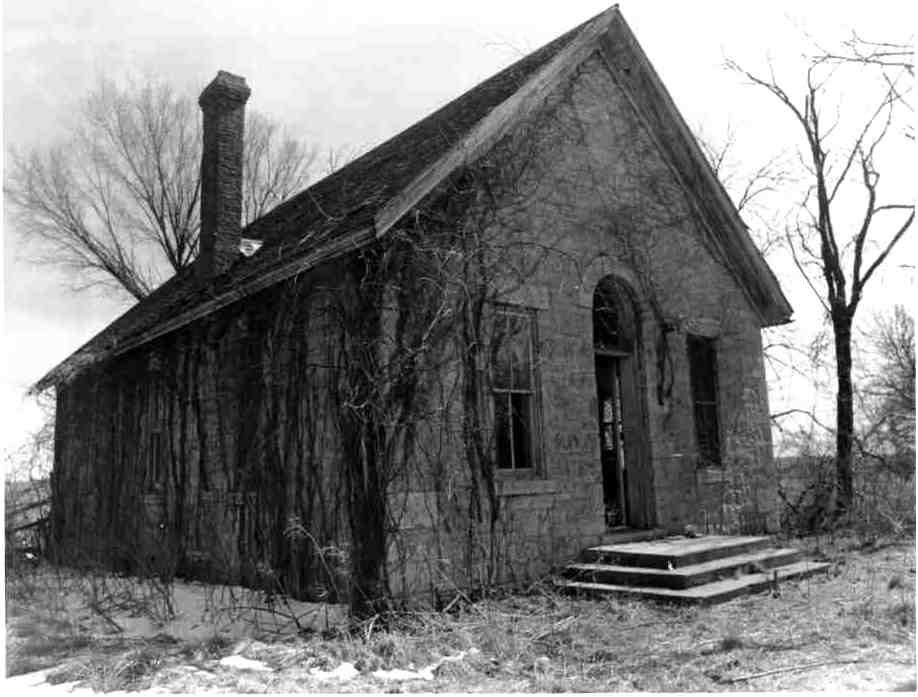
Last intact building of the Kaw Agency near Washunga, constructed in 1873 of native stone. National Register of Historic Places, April 11, 1973
The Kanza are strong people with strong allies and strong connections with the land. John Joseph Mathews writes about these alliances and these connections in describing when, in July 1724, the Kanza, Osage and Missouri alliance gave escort to Sieur de Bourmont. A glimpse of their physical prowess and spiritual strength is found in the following words. "Even though it was July and they traveled cross-drainage on the bluffs of the Missouri River above the twisting, sometimes narrow flood plain, dipping into the limestone canyons and climbing out bathed in sweat and tormented by insects, they would dance some time during the night's encampment and fire their fusils in joy shots. They had no need to take precautions; their party was a large one, and they were in Osage-Kanza-dominated country." Mathews speaks of their alliance with one and the other. "They camped on the high leases of prairie, among the trees where night winds might discourage the mosquitoes. Soon the fires would cast jagged, animated shadows. (They)..... would dress in their dance clothes and paint their faces with paint from their paint bags and dance a social dance . . . which was intertribal. The singers would beat the rhythm on a drum and sing the Siouan songs they all knew well. They would be bare from the waist up, and they would wear hawkbells stitched to a band which was tied about the leg just below the knee. These bells sounded in earth rhythm, and the fantastic hatchets they got in trade with the French were held in the striking position." Their connectedness with the Earth is gleaned from the following words. "Long after the encampment grew quiet, the grass-roots insect singers would continue the rhythm and even the metallic tone of the bells. The warriors could go to sleep to their own rhythm of well-being."
Mathews notes that the Kanza played an important part in this Nation' s history. "Because of the lure of the Mississippi and the Missouri rivers for adventurers and traders and trappers and prospectors, and because" the Kanza, and their allies, "lived on the highway that was the Missouri River, they were not only the first Missouri River tribes met with by the exploring French, but were of great importance to their plans." "Of the Siouan tribes, the Konza . . . may have the honor of being the first Siouan tribe met by the European . . . . "(Mathews) Unrau notes that, "By the early eighteenth century, the Kanza (Kanza) had achieved a position of dominance on the prairie-plans west of Missouri."
However, as Mathews' history tells us, with the incessant migration of Europeans to America the Amer-European began gaining numerical superiority and "he became more and more arrogant . . . The mighty warrior inspired fear no longer; he was only in the way, and Amer-Europeans became contemptuous of him in the communities where he outnumbered the painted warriors, but when they were few out on the prairie or plains trails the free men and the trappers almost groveled and called him 'Mr. Injun." (Mathews) And we know from Unrau that by 1819 government "negotiations were already under way --- negotiations which prepared the way for several land cession treaties that would force the Kanza to abandon the Lower Missouri and Kanza valleys and clear the way for traders, land jobbers, and farmers."
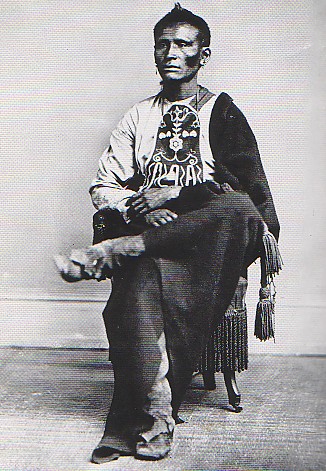
Pi-Sing (Game), Kaw Warrior
ca. 1868, Washington, DC
Smallpox had struck the Tribe in 1755 and by the end of the decade the Kanza population had been reduced by fifty percent. For the next century the Kanza was chronically afflicted with this terrible disease. Government Agents insisted that most of the Tribal members had been vaccinated for smallpox, yet the death of more than four hundred people in the epidemic of 1853 - 1855 told otherwise. (O'Bregon) The Kanza survival attests to their physical, spiritual and psycho-social strengths. According to Unrau, "During the early nineteenth century, the Kansa (Kanza) population stabilized, indicating a valiant struggle to survive against great odds in the trans-Missouri west." And further, "A significant aspect of this vitality was a strong Kansa (Kanza) cohesion at the family level."
Two hundred years ago the Kanza lived near the confluence of what is today known as the Kansas and Missouri Rivers. The Lewis and Clark Expedition of 1804 visited one of the Kanza villages situated high on bluffs overlooking the Missouri River and the explorers had the location noted on their maps. Subsequently, non-Indian settlers moved into this place and renamed the site Atchison, Kansas. The Tribe moved to a new location along the Kansas River to where it converges with the Big Blue. The tribe's population at that time was approximately one thousand seven hundred (pop. 1,700). The settlers again followed and camped just west of the Kanza - modern day Manhattan , Kansas.
In 1825, a treaty was signed by the Kanza Tribe and the United States Government in which the Tribe "agreed" to sell a larg portion of its land base for the relocation of eastern tribes. The tribe moved its location to a spot further east (ten or so miles west of present day Topeka, Kansas) . Later, in 1846, the Trib signed another treaty with the U.S. Government, giving up more land, and relocated southward along the Neosho River (near what is known today as Council Grove, Kansas). The Tribe's population remained about 1,700 in number.
The Kanza Tribe remained along the Neosho until 1872 when an Act of Congress, not a treaty, resulted in the Tribe selling its land in Kansas and purchasing a new reservation in Oklahoma. This reservation had 100,000 acres and was adjacent to the Arkansas River. Although, by this time, the Tribe's population had been decimated by disease and was only 500 in number, all able men, women and children went on their last general buffalo hunt and were successful.
In 1902, Tribal representatives presented a proposed agreement to Congress (which was prepared in part by a follow tribesman, U. S. Representative, Charles Curtis, who would later be elected Vice President of the United States). This proposed aqreement influenced Congress to pass an Act which allowed for each member in the Tribe to receive 405 acres of reservation land with the remaining land to be opened up to white settlement. Shortly thereafter qualified members could have federal restrictions removed from their land resulting in most of them losing their land.
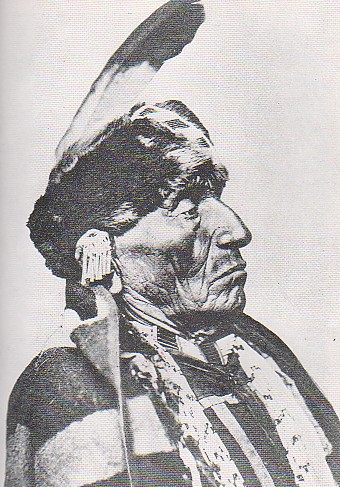
Chief Wah-shun-gah
Principal chief in the 1880s
In the 1990s, Kanza population was one thousand six hundred thirty three (1,633), of which five full-bloods were identified. These were Edgar Pepper, Clyde Monroe, William A. Mehojah, Jesse Mehojah, Jr., and Johnny Ray McCauley. They will live in the memory of the People, in their dreams while awake, in their dreams while asleep, in de ja vou. As surely as the names Al - le - ga - wa - ho, American Chief, Big John, Big Wolfe, Hard Chief, Hard Hart, Ke-kah-bah, No-pa-my, No-pah-wiah, White Hair, White Hair Striker, White Plume , The Wolf and Kanza live in the minds and the hearts and the words of the People these last five will also live. These and all Kanza live in collective memory, live in the gen pool, live in the names of the Kanza youth. Yearly when the People come together at the old Council House by Washunga Bay. Their presence is felt and known and understood in the drumming of The Drum, in the rhythm of the bells, in the songs they all know so well. Voices of Kanza men and Kanza women rise and fall in complex harmony with one another , with the Drum , the bells and The Wind. Each year The Dance is as old as yesterday and as new as tomorrow.
The Kanza are The People of the South Wind. They have lived long with the South Wind and the South Wind with them. The Wind travels far and fast and knows the movements of the Buffalo and other foragers. The Wind conducts reconnaissance on enemies and carries messages to and from allies. The Wind knows where nuts, fruit and grains grow and the hiding place of squirrels, rabbit, and turkey. It is not surprising the Kanza consult the South Wind --- Tribal Attorneys prior to going into court, Tribal Housing prior to selecting and securing home sites, Tribal Council and Staff developing businesses and enterprises, Tribal members prior to and during the meeting of the Kanza General Council.
The Kaw lands are now part of Kay County, and the tribal headquarters are located in Kaw City
Visit the Kaw Nation official website to learn more about the Kaw people.
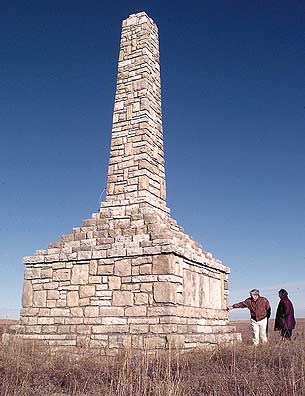
William Borst, of Emporia, Kansas, left, and Sharon Haun, of Council Grove, Kansas, admire the 35-foot-high monument, erected in 1925. The monument marks the grave of a Kaw warrior's remains that were found on the land southeast of Council Grove.
The "Unknown Kanza Warrior" is a thirty-five-foot high stone spire built by local citizens in 1925 as a tribute to the memory of the Kaws' presence in the area. This commemorative act was prompted by the discovery of a warrior's remains exposed by cut bank erosion in a nearby streambed. The warrior and his burial paraphernalia were re-interred in the base of the monument in August 1925 during an elaborate dedication ceremony attended by several members of the Kaw tribe.The memorial is located on the grounds of the Allegawaho Memorial Heritage Park, south of Council Grove, Kansas, off S. 525 Road. The park is the site of the last Kanza village in Kansas.
The park also includes the ruins of 1860s government-built stone buildings, and In'zhuje'waxobe, a sacred 28-ton red quartzite boulder rematriated to the park in 2024.
Visit the Kaw Nation's Allegawaho Memorial Heritage Park article to learn more.
Page updated:

State Coordinator: Linda K. Lewis
Asst State Coordinator: Rebecca Maloney
Designed by Templates in Time