


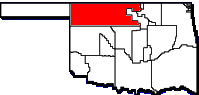
Cherokee Outlet/Strip
The Cherokee Outlet, or Cherokee Strip, was was created by a 1834 treaty signed at Fort Gibson. Due to a surveying error, lands ceded to the Cherokee as par of the Cherokee Outlet resulted in a two to three mile section of land in Kansas, known as the Cherokee Strip. Over time, the entirety of the Cherokee Outlet was often called the Cherokee Strip.
The lands of the Cherokee Outlet remained relatively unused until after the Civil War. Texas cattleman driving their herds north to the railheads in Kansas crossed the Outlet stopping occasionally to graze their cattle and let them fatten a little before driving them the final miles to market. The unused grasslands were a tempting oasis along the dusty Chisholm Trail. The next step was grazing the herds in the Outlet throughout the grazing season. It was much easier to raise cattle near the railheads than to make the long trip north from Texas. Six million acres of free grass was in the Outlet for anyone who would take it.
Then, in 1880, the Cherokees decided they were being robbed again by white men. In the Cherokee Council that year they set a herd tax of $1 on all cattle being grazed on their land. The cattlemen protested and for at least part of the year, the tax was reduced to 40 cents a head. Still the Cherokees were not satisfied with the system because they had to depend on the cattlemen for an accurate count. The cattlemen were not satisfied either, because they had no way governing the vast expanse of grass. In March, 1881, several of the cattlemen gathered at Caldwell, Kansas to talk over the situation. Nothing much came of the meeting except for an arrangement to register their brands. A second meeting the following year resulted in an agreement that all cattlemen in the Outlet must stand together.
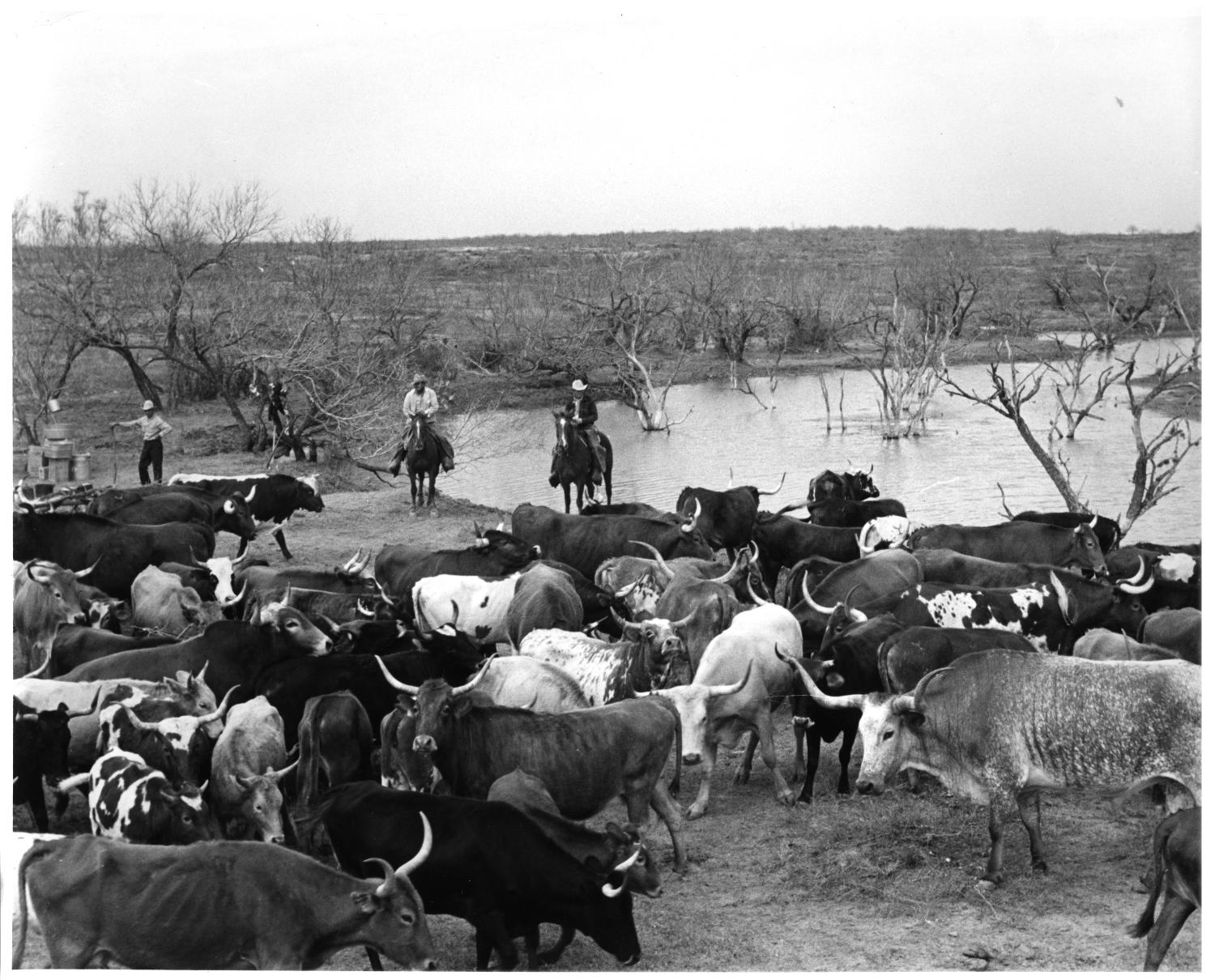
At the third meeting, held in March 1883, the Cherokee Strip Livestock Association was organized. Major Andrew Drumm was elected president of the association and Charles Eldred secretary. Headquarters of the Organization would be in Caldwell. The organization signed an agreement with the Cherokees to lease the entire Outlet for five years at $100,000 a year. Each year a wagon load of silver dollars was hauled from Caldwell to the Cherokee capitol at Tahlequah where it was counted, dollar by dollar, into the hands of the Indians. Ranches were then leased by the livestock association to stockholders. Beef became the most profitable investment in the country. Investors included many congressmen, senators, industrial giants and in some cases, the crown heads of Europe. When the lease expired , the Cherokees wanted a larger share of the profits. A new lease was signed paying the tribe $200,000 per year for use of the lands in the Cherokee Outlet.
Within months of the completion of the second cattle lease, Congress appointed a commission to talk with the Cherokees about selling their lands in the Outlet. The commission was authorized to offer the Indians $1.25 an acre for their land. Learning of this, the cattlemen made an offer of their own of $3 an acre. When the commission failed to reach an agreement, Secretary of the Interior John Noble studied the treaty with the Cherokees and decided their title to the lands in the Cherokee Outlet was not absolute. In his opinion, the government had only given the Cherokees an easement. Since they didn't use it, Noble felt they should forfeit their rights to the Outlet lands. The Commission of Indian Affairs disagreed with the Interior Department ruling, but the Attorney General sided with Noble and against the Indian claims. The argument raged for many more months until, in 1890, President Harrison ordered all cattle to be removed from the Outlet by the end of the year. Association members were ordered to remove every fence, every house, every improvement of any land. The Army was sent in to ensure the order was carried out.
No longer able to collect lease money from the cattlemen and faced with confiscation of the land by the government the Cherokees finally agreed in 1891 to sell the land back to the government for $8.5 million. The agreement provided that if congress did not come up with the money by March 4, 1893, the treaty was void. On the day before the deadline, Congress appropriated $8.3 million. It was short of the agreed amount, but Cherokee leaders took it rather than risk of being stripped of all rights.
The title to the Outlet was cleared in May and on September 16, 1893, in the greatest land run ever held, the vast grassland was opened for white settlement. For a few brief years, cattle had been king in the Cherokee Strip. Within a few more years, wheat would rule the economy of Northwest Oklahoma.
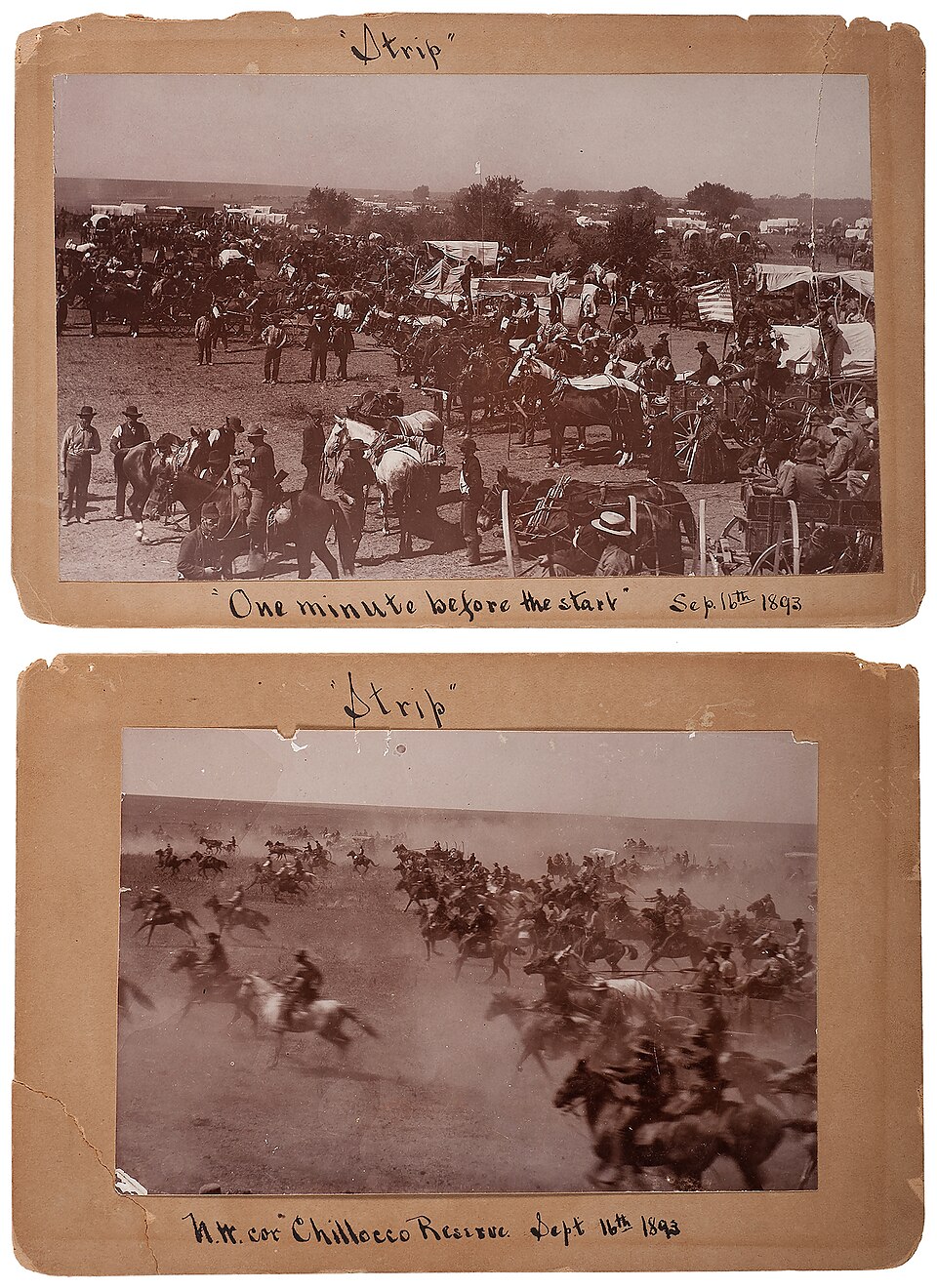
President Grover Cleveland designated September 16, 1893, as the date of the opening of the Cherokee Outlet that Congress had paid $8,505,736, or about $1.40 per acre for. Soon word spread across the land and later became known as the "greatest horse race ever."
Immigrants and citizens from all over the United States, loaded their belongings into wagons and on the back of horses. As these hopefuls swarmed the Kansas and Oklahoma Territorial borders, impatiently waiting for the Cherokee Outlet to be opened. On that day in 1893 more than 100,000 white settlers rush to claim six million acres of former Cherokee land. By the end of the day, farms were established, and the cities of Enid, Perry, Alva, and Woodward had risen out of prairie from the day before.
The Homestead Act of 1862 made surveyed lands obtainable to homesteaders. The act stated that men over the age of 21, unmarried women who were head of households (i.e. widows), and married men under the age of 21, who did not own over 160 acres of land anywhere, were citizens or intended on becoming citizens of the United States, were eligible to homestead. Home seekers had to register in advance of the "run". Participants were to provide their names, addresses, ages, and a description of themselves, along with their signature on an affidavit that they would not enter the Outlet before noon September 16, 1893.
Successful contestants had six months to prove up their claims. Most did not leave their claims unattended due to "claim jumpers". After five years, surviving claimants could secure a patent deed by appearing at the land office and making the final proof of residence, paying $1.25 to $1.50 per acre and a land office fee of $7.00.
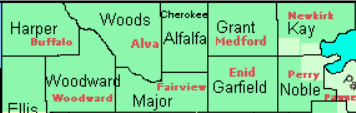
The following counties, or portions thereof, occupy the land of the Cherokee Outlet / Cherokee Strip
Page updated:

State Coordinator: Linda K. Lewis
Asst State Coordinator: Rebecca Maloney
Designed by Templates in Time