


Welcome to the Absentee Shawnee history and genealogy page. Whether you are tracing an Absentee Shawnee ancestor, researching a Shawnee family in Oklahoma, or exploring your family's connection to Indian Territory, these resources can help you follow your family through the historical record.
The Absentee Shawnee are one of the three federally recognized Shawnee tribes in Oklahoma. Their history is distinct from that of the Eastern Shawnee and the Shawnee Tribe. They traveled from the Shawnee homelands of the eastern United States to Missouri, Kansas, Indian Territory, and present-day Oklahoma. Census rolls, agency records, allotment records, family registers, and other historical documents can help connect generations and reveal where your ancestors lived, married, raised their families, and received land. Begin with the most recent ancestor you can document and work backward, using each record to establish the next generation.
Linda K. Lewis, Site Coordinator
| Date | Event |
|---|---|
| Late 1700s | Some Shawnee communities moved west from their Ohio homeland into the Mississippi Valley and Spanish Louisiana, eventually settling near present-day Missouri. |
| 1825 | The Shawnee in Missouri accepted a reservation in Kansas. Some members of the group that would become known as the Absentee Shawnee did not settle there. |
| 1830s-1840s | Shawnee families who had remained away from the Kansas reservation moved into Indian Territory. By about 1840, many were living along the Canadian River in areas associated with the Choctaw and Creek Nations. |
| 1854 | A treaty attempted to encourage the Absentee Shawnee to return to Kansas, but the effort was unsuccessful. |
| Civil War | Shawnee communities were disrupted by the war. Some Kansas Shawnee joined the Absentee Shawnee in Indian Territory, while many families became refugees in Kansas. |
| 1872 | Congress confirmed the Absentee Shawnee's title to lands in Indian Territory that had been associated with the Potawatomi. |
| 1890-1891 | Absentee Shawnee lands were allotted to individuals, ending the tribe's communal landholding system. |
| 1936 | The Absentee Shawnee Tribe organized under the Oklahoma Indian Welfare Act and adopted a constitutional form of tribal government. |
The Absentee Shawnee homeland in Oklahoma developed primarily in central Oklahoma, and the tribal government is headquartered in Shawnee. The tribe continues to maintain its government, community, language, and cultural traditions.
The term Absentee Shawnee developed because members of this Shawnee community were absent from the Shawnee reservation established in Kansas in 1825. Historical records may therefore use several different descriptions for the same family or individual.
When searching records, look for variations such as:
A record identifying an ancestor simply as Shawnee should not automatically be assumed to represent the Absentee Shawnee Tribe. Compare the person's residence, agency, family relationships, land records, and other documents before assigning a specific tribal connection.
Absentee Shawnee genealogy can often be traced through Indian census rolls and agency records. These records are especially valuable because many contain family groupings, ages, relationships, residence information, and changes from year to year. A useful starting point is the 1875 Census of the Absentee Shawnee. Later records were created through the Sac & Fox Agency and the Shawnee Agency. The Oklahoma Historical Society's catalog identifies numerous Absentee Shawnee census records, including family registers and separate birth, death, and marriage records.
The following records are particularly useful for reconstructing Absentee Shawnee families:
The National Archives identifies Absentee Shawnee census material among the records of the Shawnee (Sac & Fox) Agency and lists Absentee Shawnee census rolls from 1915 through 1938 among its Bureau of Indian Affairs records.
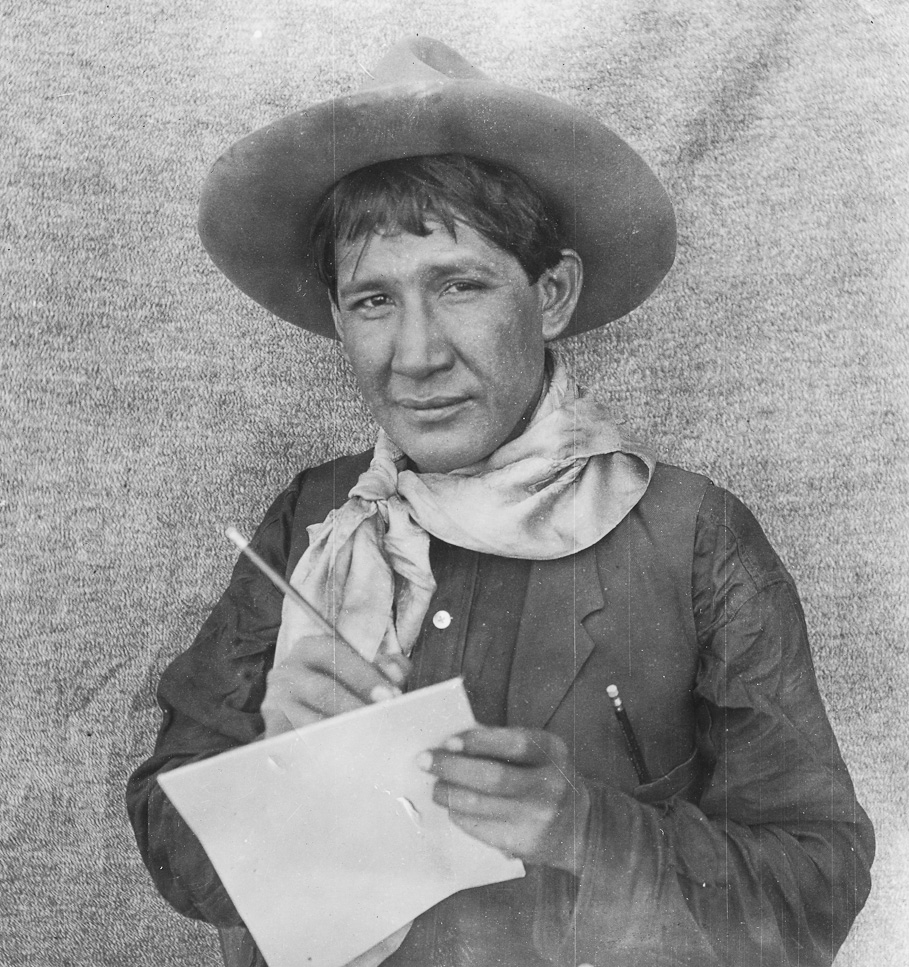
Ernest Spybuck, ca. 1910
Artist, Absentee Shawnee
Do not limit your search to annual census rolls. The Absentee Shawnee Family Register covers 1895-1933 and can be particularly useful for connecting parents and children across census years. Later Shawnee Agency records include separate records for births, deaths, and marriages. These can provide information that is not present on an annual census, including dates and family relationships.
The Oklahoma Historical Society provides a searchable catalog of these records through its American Indian Census collection: Absentee Shawnee Census Records
Absentee Shawnee lands were allotted in 1890 and 1891. Allotment records can be extremely valuable to genealogists because they may connect an individual to a specific parcel of land and provide information about age, family, residence, or legal status. The National Archives' Fort Worth holdings include Absentee Shawnee allotment records dating from about 1893, as well as an 1891 allottee schedule. These records should be searched alongside county land records and later deeds. See American Indian Records on Microfilm
Agency records are an important source for Absentee Shawnee research. The Bureau of Indian Affairs records include material from the Sac & Fox Agency in Kansas and Indian Territory, the Shawnee Agency, and later Western Oklahoma agency offices. These records can include correspondence, census rolls, allotment material, financial records, applications, birth and death records, and other documents concerning individual tribal members. See BIA Records: Oklahoma
For researchers interested in documenting descent from an Absentee Shawnee ancestor, the tribal Enrollment Department is an important source for current enrollment requirements and official documentation. The tribe's published descendant instructions indicate that applicants may need birth and death certificates linking the applicant through parents and grandparents to the last individual enrolled with the Absentee Shawnee Tribe. Genealogical research should therefore focus on documenting the complete chain of relationships rather than relying on a family tradition or a single record. See their Enrollment Department, Enrollment Department, and Descendant Letter Instructions pages.
Absentee Shawnee genealogy often requires following a family through several different record systems. A name may appear first on an Indian census, then in an agency family register, an allotment file, a county land record, or a later Oklahoma vital record. Keep a record of every source you find, including the agency, census year, roll or microfilm number, and page or line when available. Comparing records from multiple years can reveal changes in names, ages, relationships, and places of residence that help establish a reliable family connection. The goal is not simply to find a name, but to document the family connections that place that person within the history of the Absentee Shawnee community.
Page updated:

State Coordinator: Linda K. Lewis
Asst State Coordinator: Rebecca Maloney
Designed by Templates in Time